


Everything begins with breath
We are taught that breath is about oxygen. About survival.
But this is only the surface.
Breath is movement. Rhythm. Internal massage.
It shapes posture. It signals safety. It drives the quiet currents of the body — lymph, digestion, detoxification, hormonal balance.
And not just any breath will do.
Why Diaphragmatic Breath Matters
When the diaphragm moves well, the whole body responds.
This large, dome-shaped muscle — resting just beneath the lungs — creates the pressure shifts that mobilise deep, internal systems.
It draws breath into the belly, expands the ribs, moves the spine, and gently compresses the abdominal cavity.
This movement isn't incidental — it's essential.
The body contains approximately 600 lymph nodes.
More than half reside in the abdomen — around the liver, gut, spine, and kidneys.
These nodes do not respond to shallow breath. They are stirred only by the full, slow descent of the diaphragm.
When we breathe deeply, the lymph flows. Waste clears. Immune cells move.
Organs receive the subtle compression that keeps them supple, oxygenated, alive.
Digestion improves. Hormones find balance. Inflammation softens. The body begins to release what it no longer needs.
What Happens When the Breath Moves Up
But most of us don’t breathe this way. Not anymore.
For many, breath has climbed — out of the belly, into the upper chest.
We inhale in short, shallow sips. We brace the abdomen. We lift the shoulders.
We do it quietly, often without knowing, as the nervous system adapts to the pace and pressure of life.
Posture tightens. The stomach holds in.
Stress becomes constant. The breath becomes high and fast.
And the diaphragm — once central to the body’s internal movement — falls silent.
When the diaphragm doesn't move, the lymph doesn't flow.
Waste accumulates. Detox slows. Nutrients circulate less efficiently.
And while the body may continue — functioning, coping — it is not restoring.
Why We Forget
We forget to breathe into the belly not because we don’t know how, but because the body learns to protect itself.
Tension in the abdomen often carries the weight of unspoken fear, shame, vigilance.
Holding the stomach tight can feel safer than letting it soften.
And so we stop descending.
We hover in the chest. We remain prepared. And the breath becomes survival rather than nourishment.
Breath as Foundation
Diaphragmatic breath is not a performance.
It is a conversation between the body and its deeper rhythms.
It is the foundation beneath digestion, lymphatic flow, immune regulation, and emotional steadiness.
It is not just a stress relief tool — it is structural. Hormonal. Detoxifying. Foundational.
For those trying to restore balance — through food, movement, minerals, or somatic work — the breath must come first.
Because without it, the body holds on. To fluid. To waste. To stories.
And no supplement can override a system that’s been told to brace.
A Return, Not a Technique
This is not about perfect breathwork or technique.
It is about remembering. A function we were born with. A rhythm the body still knows.
And we return not with force, but with trust.
One slow inhale into the belly. One soft, grounded exhale. Again and again, until the body hears:
You are safe to soften now.
You are safe to move again.
You are safe to let go.


The Weight of Unspoken Things: How the Jaw Shapes the Body
There are places in the body that speak without words. The jaw is one of them.
The temporomandibular joint — the TMJ — is small. Easily overlooked. Tucked just in front of the ear, where the lower jaw meets the skull. But its influence runs deep.
We clench when words go unsaid.
We tighten when space is needed but not granted.
We grind when caught between tenderness and responsibility.
And for many — especially those in caregiving roles, in the quiet, relentless work of mothering — this tension becomes a constant companion. The jaw learns to soften for lullabies, but it also learns to hold back needs, to brace, to endure.
The Hidden Dialogue Between Jaw and Pelvis
What happens in the jaw does not stay in the jaw. Through fascial and neurological pathways, tension held here travels—often silently—into the neck, the spine, and downward through the body’s architecture.
In somatic therapy, there is a principle known as Lovett’s Reflex. It describes a mirror-like relationship between the upper cervical spine and the lower sacrum. What affects the neck can echo in the pelvis, the hips, even the placement of the feet.
When the TMJ is tight, it can subtly shift the alignment of the first and second cervical vertebrae—an area nestled close to the vagus nerve, the body’s great regulator of internal calm. This can disturb the body’s sense of safety, its breath, its balance.
In this way, a blocked jaw can set the whole body on edge. The pelvis tightens. The breath shallows. The feet grip. We lose our ground.
Tension That Speaks of More Than Injury
For many, jaw tension is not born from trauma or dental concerns. It is the result of a thousand small silences.
- The smile held a little too long.
- The conversation avoided, to keep the peace.
- The daily weight of responsibility, unrelieved and unshared.
Over time, this becomes a posture. Not just of the face, but of the nervous system.
The jaw becomes the threshold — the place where we hold ourselves together.
Safety Begins with Softening
Softening the jaw is not merely physical. It is an act of trust. A quiet signal to the nervous system: You no longer have to brace.
And when the jaw lets go, the pelvis often follows. These two regions are in constant, quiet dialogue. When one releases, the other listens.
From this release, change unfolds:
- Breath deepens.
- Posture softens.
- The body reclaims its sense of ground and grace.
And it begins with something as small as the jaw.
The Small Joint That Shapes the Whole Body
The TMJ is more than a hinge for chewing. It is a convergence point—of expression, restraint, tension, and survival. And through its quiet influence, it shapes far more than we realise.
When this joint begins to unwind, it does more than relieve pressure. It recalibrates the nervous system. It restores fluidity to movement. It reopens the internal conversation between strength and softness.
If your hips feel tight, if your body struggles to relax, if your breath doesn’t quite reach the belly—consider the possibility that it begins in the jaw.
Begin there.
Begin gently.
Begin with softening what has long been held.
And notice what follows.
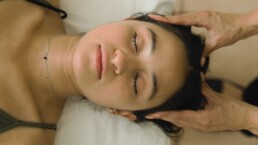
Massage for relaxation is not a luxury
Massage for Relaxation Is Not a Luxury
Needing to relax is not a frivolous desire. It is a signal.
You didn’t book a massage on a whim. You likely felt the strain—physically, mentally, emotionally. Perhaps you’ve been carrying too much for too long. The weight of tension, restlessness, poor sleep, or a mind that simply won’t quiet.
These are not minor concerns. They touch every part of your well-being. And they are just as worthy of support as physical pain or injury.
Relaxation Is Not Indulgent. It’s Essential.
We’ve been conditioned to see rest as a luxury—something earned after exhaustion. But true relaxation is not a reward. It is a vital part of being well.
Massage offers more than physical ease. It invites your entire system to slow down. It creates space for your breath to deepen, your thoughts to soften, and your body to remember a quieter state of being.
This isn’t “just a treat.” It’s a form of care. One that allows your nervous system to recalibrate, your body to reset, and your mind to clear.
Stress Doesn’t Dissolve in a Single Hour
Life rarely pauses. The pressure to manage, to care, to perform—it builds. And although one massage may bring momentary peace, true restoration unfolds over time.
Think of it as you would with sleep. One good night can help, but it is consistent, nourishing rest that allows you to heal.
Massage works in the same way. With each session, your body relearns how to release, how to soften, how to trust the stillness. And gradually, change begins to root itself within you.
Many Have Forgotten What It Feels Like to Truly Relax
For many, stress has become the baseline. A constant hum of alertness, often so persistent it becomes invisible.
In this state, real relaxation is unfamiliar. Elusive. But that doesn’t mean it’s unreachable.
Through regular treatments, the body can learn a new pattern. It begins to respond more quickly, to stay calmer for longer. The more it is reminded of safety, the more it believes in it.
And with that shift, other things begin to move—sleep deepens, moods stabilise, clarity returns.
This Work Is About More Than Muscles
Massage is not only about releasing tension. It’s about creating refuge. A space to return to yourself when the world has pulled you too far outward.
If you left your session breathing more fully, thinking more clearly, or simply feeling a little more like yourself—that matters.
Your body is speaking. And it is asking for more of what helped it feel safe.
You are allowed to answer that call. Not as indulgence, but as necessary care.
A Quiet Invitation
Massage can offer many things: stillness, release, reconnection. But most of all, it offers rhythm. A steady return to centre, again and again.
You need not wait until something aches. You are already carrying enough.
Let this be where you begin to set it down.
If you feel ready to build on today’s work, we can find a rhythm that suits you.
It doesn’t have to be frequent. Just regular enough to make a meaningful difference.
This is your invitation. Let’s listen to what your body truly needs.